Reality as we know it
Before physics becomes equations, it begins with a child’s question:
Where is it?
When did it happen?
What made it move?
Where will it go next?
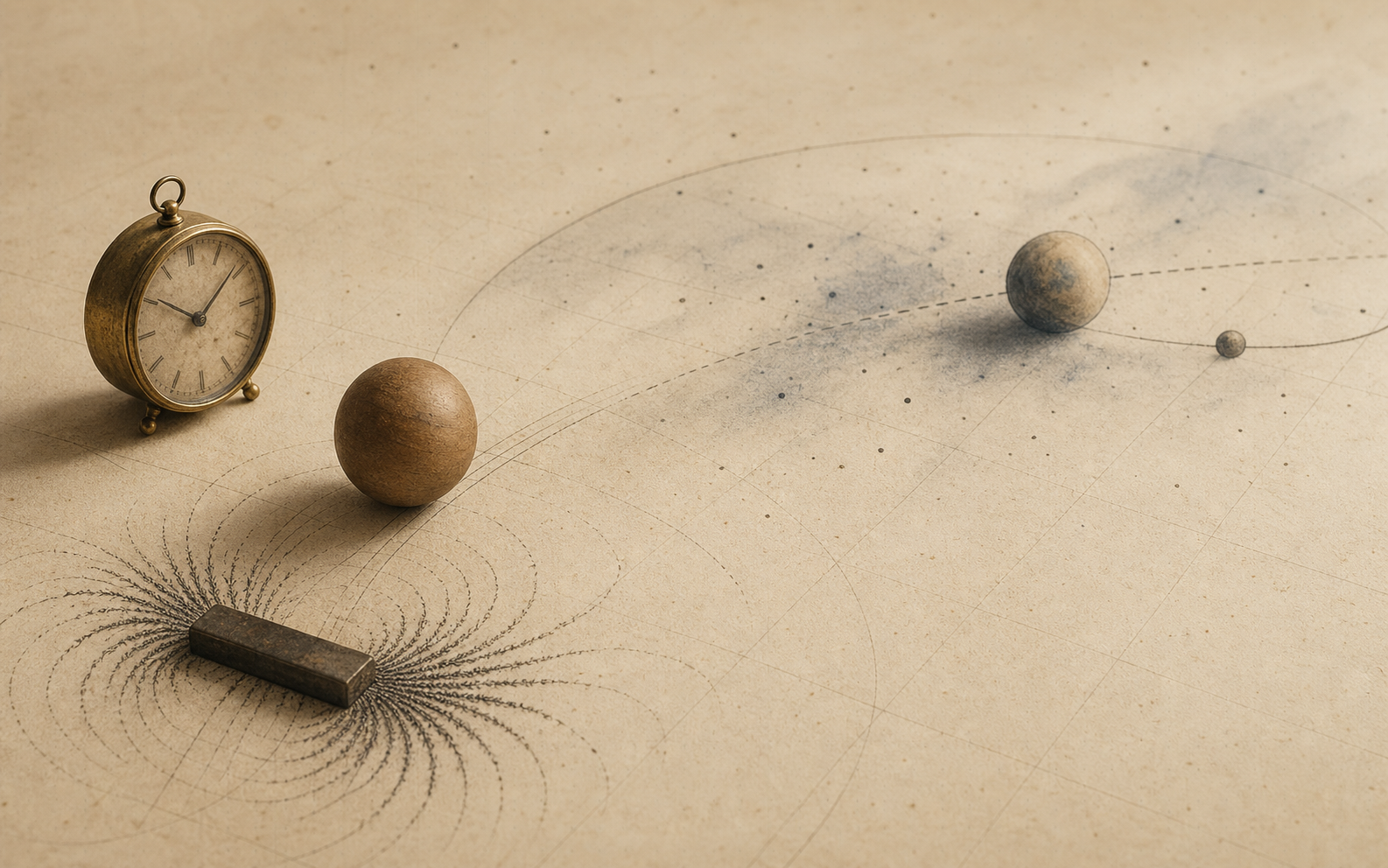
A ball rolls across the floor. A planet falls endlessly around the sun. A magnet pulls iron filings into curved lines. A spark jumps, a wave spreads, a clock ticks, a body accelerates, a star bends light. The subjects change, but the grammar is familiar: something is somewhere, something happens at some time, and nature follows rules that connect one moment to the next.
For centuries, physics learned to make this grammar precise. Newton described motion through space and time, showing how forces change the paths of bodies. Maxwell revealed electricity, magnetism, and light as one woven set of laws. Einstein changed the meaning of space and time themselves, showing that gravity is not simply a pull between objects but a curvature in the structure through which objects move. Quantum mechanics went deeper still, teaching us that matter and energy obey rules stranger than common sense, rules of probability, uncertainty, and entanglement.
Yet through all these revolutions, one assumption remained almost invisible because it was so useful: physics described the world as events arranged in spacetime. Particles, fields, waves, planets, clocks, atoms, and galaxies could all be studied by asking how they are distributed, how they change, and how influences pass from place to place. Spacetime was not always simple. Einstein made it flexible. Quantum theory made its contents mysterious. But the familiar world still seemed to unfold within an order of location, duration, distance, and cause.
The question at the heart of this essay is what happens if that order is not the starting point.
What if spacetime is one of nature’s great collective achievements? What if gravity, locality, and the ordinary world arise from a deeper organization of relations—an organization hinted at by black holes, quantum entanglement, information, and the surprising ways nature seems to protect what can be known?
This would not make the world around us false. It would make it more remarkable. The room, the table, the falling ball, the light from a star: all would remain as solidly part of experience and science as before. But we would have to learn a new humility about them. The things most obvious to us may not be the first things in the order of explanation.
The Flock Is Real

At a distance, a flock of birds can look like a single dark creature moving through the evening air.
It bends, tightens, opens, and turns. No bird contains the whole shape. No bird carries a diagram of the flock. Yet the shape is not imaginary. It can startle you. It can cast a shadow. It can make a child point upward and forget, for a moment, to speak.
The flock is real.
But its reality is not the reality of a single bird.
It exists as a pattern of relations: distances kept, turns copied, speeds adjusted, threats answered, signals passed through motion rather than command. The larger form is not painted onto the birds. It gathers from them.
Physics may be learning to think this way about the world itself.
Not that tables, planets, storms, and bodies are pretend. Not that the room around you is a trick. The ordinary world has weight, consequence, texture, and law. You can lean on it. You can be wounded by it. You can love within it.
But the question is whether space, time, and gravity are the first ingredients of nature, or whether they are more like the flock: genuine, dependable, and yet arising from a quieter order of relations beneath the familiar one.
That possibility has become difficult to ignore.
It has not been proven for our universe. It is not a finished theory. It is not a slogan. But across several of the deepest ideas in modern physics—black-hole thermodynamics, holography, quantum entanglement, quantum information, and error correction—the same hint keeps appearing:
Perhaps the world is held together first by relations, and only afterward appears as a place.
The question is not whether the world is real. The question is what kind of reality space and time have.
The first crack in the wall
For a long time, space seemed like the most obvious thing in the world.
Objects occupied it. Light crossed it. Planets curved their paths through it. Einstein made space and time more strange, but also more powerful: not an empty container, but a dynamic spacetime whose curvature is what we experience as gravity.
This was already a profound shift. Gravity was no longer merely a force pulling objects together. It became the shape of spacetime itself.
Mass and energy tell spacetime how to curve. Curved spacetime tells matter how to move.
That picture remains one of the greatest achievements of human thought. It predicts the bending of starlight, the slowing of clocks, the expansion of the cosmos, the existence of gravitational waves. It is not an abandoned vision. It is astonishingly successful.
But black holes placed a strange pressure on it.
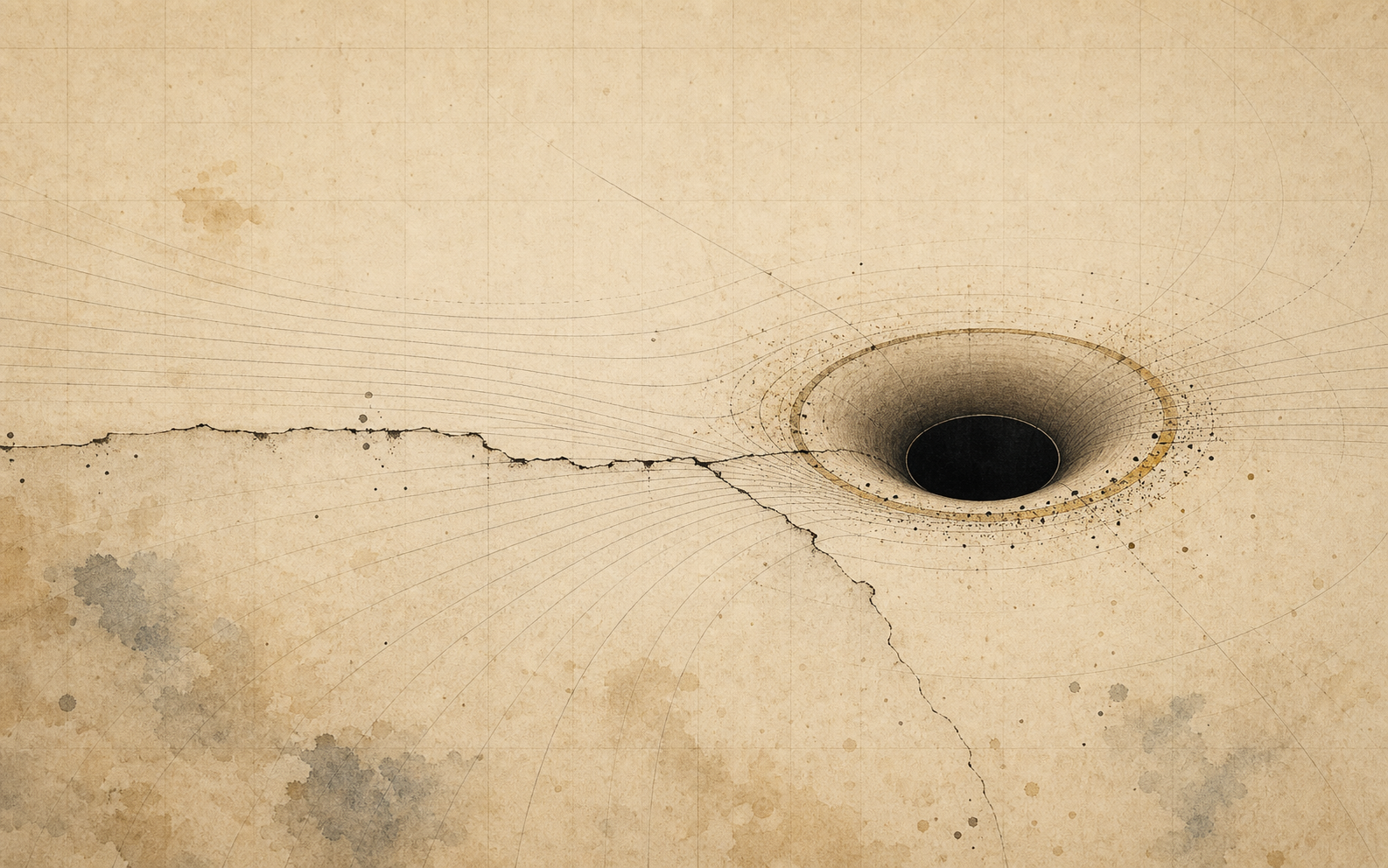
A black hole is what happens when gravity becomes so intense that a region of spacetime is cut off from the outside world. Cross the horizon, and no signal can return. From far away, the horizon behaves like a surface of no escape.
Classically, this seemed final. Matter falls in. The outside loses access. The black hole is described by only a few visible quantities: mass, charge, and rotation. Everything else—the detailed history of the matter that formed it—appears hidden.
Then thermodynamics entered the story.
Jacob Bekenstein argued that black holes should have entropy. Stephen Hawking showed that black holes radiate. They are not perfectly black. They have a temperature.
This was shocking because temperature and entropy are not usually properties of empty geometry. They belong to systems with many microscopic possibilities: gas molecules in a room, atoms in a hot metal, arrangements too numerous for us to track one by one.
If a black hole has entropy, what are the hidden arrangements?
And why does the entropy scale with the area of the horizon, not with the volume inside?
That area law was the first deep clue.
For ordinary matter, entropy usually grows with volume. A bigger box can hold more molecules, more arrangements, more microscopic states. But the entropy of a black hole is proportional to the size of its horizon surface.
The black hole seemed to whisper something almost impossible:
The amount of information associated with a region of space may be measured not by how much room it encloses, but by the size of the surface around it.
That was not a poetic remark. It was a precise physical relation. It suggested that gravity, entropy, and information were not separate topics. They were somehow aspects of one problem.
A black hole taught physics to count differently.
The lesson of the horizon
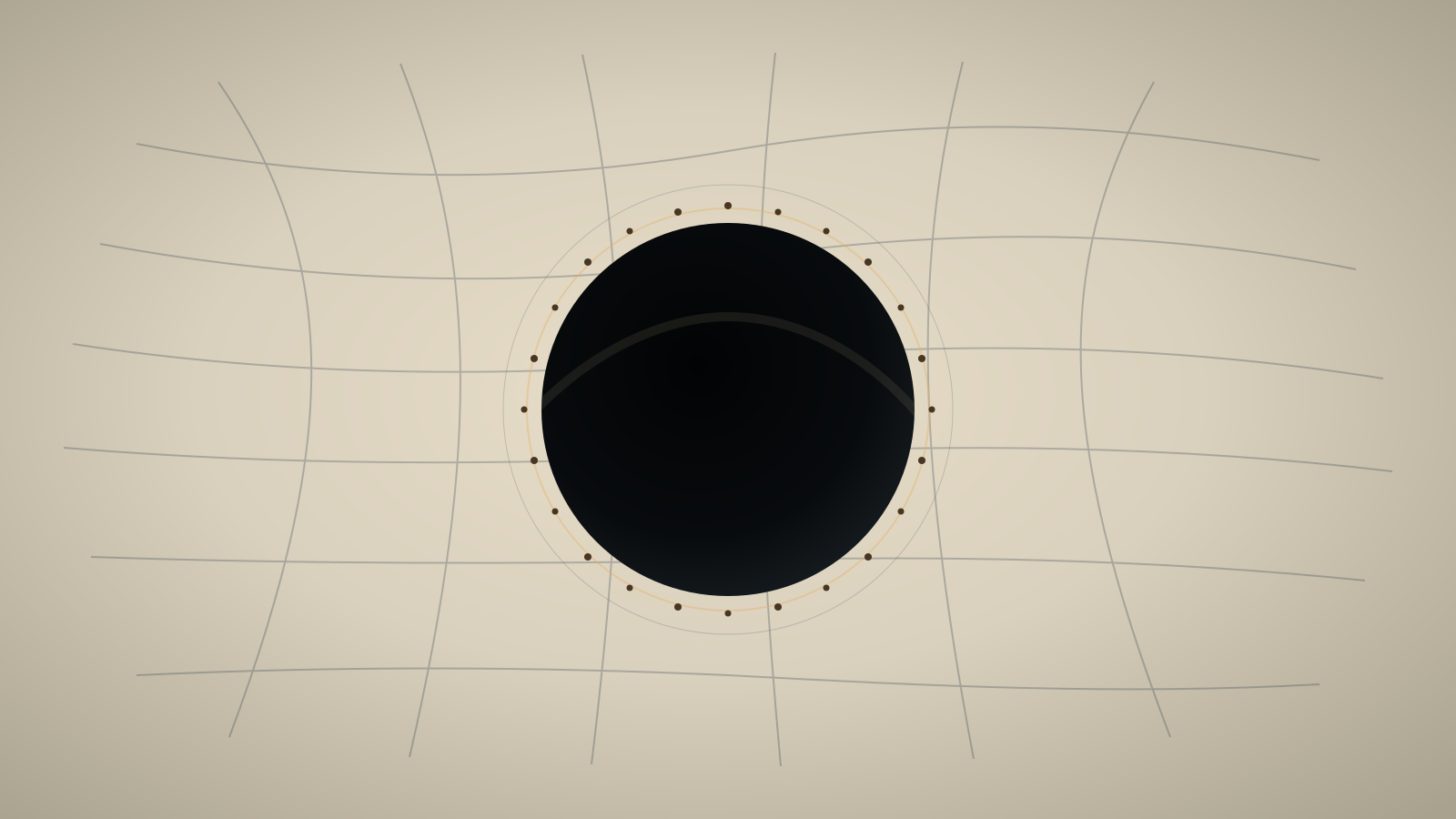
A horizon is not a wall you could knock on. It is a point of no return, a causal dividing line. Yet it behaves thermally, as if it has microscopic structure.
This is one reason black holes are so philosophically dangerous. They turn familiar categories against each other.
Geometry begins to sound like thermodynamics.
Thermodynamics begins to sound like information theory.
Information begins to sound like gravity.
The danger is not that black holes are exotic. The danger is that they may be honest.
When physics becomes extreme, it often reveals what was quietly true all along. Ordinary matter taught us about atoms. Hot stars taught us about nuclear fusion. The orbit of Mercury hinted that Newtonian gravity was not the final word. Black holes may be doing something similar for spacetime.
They suggest that spacetime has a capacity. There is a maximum amount of information that can be associated with a region before gravitational collapse changes the question. Pack too much energy into too small an area, and the region becomes a black hole. The horizon then sets the scale of entropy.
This does not mean the contents vanish from reality. It means that gravity limits how information can be localized, stored, and described.
That is already a radical statement.
We are used to imagining space as something that can be subdivided indefinitely: smaller boxes inside boxes inside smaller boxes. But black-hole physics suggests that this picture cannot be the whole story. At some depth, the independence of tiny spatial regions may fail. The world may not be assembled by assigning separate facts to every point of a pre-existing continuum.
Something else must be doing the accounting.
Not less real than space.
Prior to space, perhaps.
When the surface knows too much

The holographic principle grew from this pressure.
In its broadest form, it is the idea that the physics within a region governed by gravity might be representable by degrees of freedom associated with a lower-dimensional surface. The name comes from holograms, but the metaphor can mislead. The point is not that the world is a projected image. The point is about counting, equivalence, and description.
In certain theoretical settings, this idea becomes extraordinarily concrete. Physicists have found model universes in which a gravitational spacetime is mathematically related to a quantum theory without gravity living at its outer edge. In these models, the gravitational region and the non-gravitational quantum theory are not two different physical systems loosely resembling each other. They are two ways of describing the same underlying physics.
This is one of the strongest reasons emergent spacetime is taken seriously.
But care is essential. These models are not simply our universe. The best-understood examples often involve idealized conditions unlike the cosmos we inhabit. They give physicists a controlled arena, not a completed map of nature.
Still, controlled arenas matter. They show what is possible. They turn philosophical speculation into mathematics. They reveal that spacetime with gravity can, at least in some cases, arise from a quantum system in which gravity is not present at the start.
That is not proof that our universe works this way.
It is evidence that the old hierarchy may be reversible.
Maybe spacetime is not the arena in which quantum information lives. Maybe, in some circumstances, spacetime is one of the large-scale patterns quantum information can form.
Holography does not say the world is a picture. It says gravity may be an emergent language for information organized in a particular way.
The quiet violence of entanglement
To see why this idea is not absurd, we have to face the strangeness of entanglement.
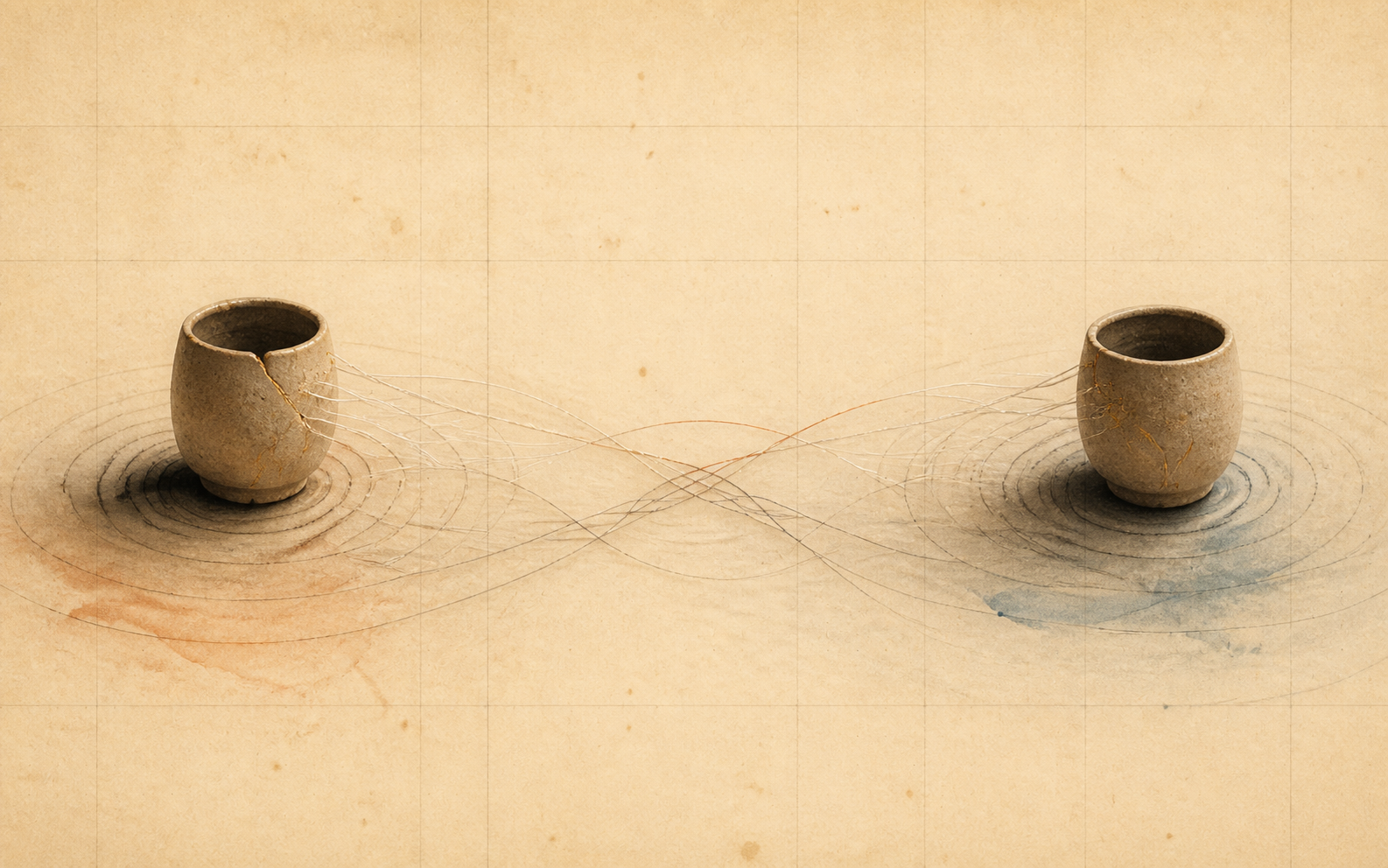
In ordinary life, we expect things to have their own states. One cup is here, another cup is there. Each can be described separately. Their relationship may matter, but it feels secondary.
Quantum mechanics does not always allow this.
Two particles can share a joint state that cannot be reduced to independent states for each particle. Measure one, and the possible outcomes for the other are constrained in ways no classical picture of separate hidden properties can reproduce.
This does not let us send messages faster than light. It does not abolish causality. But it does mean that the quantum world is not built entirely from self-contained pieces carrying their own complete facts.
The relationship can be more definite than the relata.
That sentence sounds philosophical, but in quantum mechanics it has mathematical force. Entanglement is not a mood of connection. It is a measurable structure in the state of a system. It has quantities associated with it. It can be used as a resource. It can be manipulated, distilled, protected, consumed.
And in holographic theories, entanglement appears to know about geometry.
One of the most striking discoveries in this field is that the amount of entanglement between parts of the underlying quantum system can be related to areas of surfaces in the associated spacetime. Again, this is not a vague analogy. In the right theoretical setting, it is a precise relation.
Area, which sounds geometric, can be computed from entanglement, which sounds informational.
That is a reversal worth sitting with.
We usually think two things are entangled because they occupy parts of space and interact. But these ideas suggest a deeper possibility: spatial connectedness itself may be a consequence of how quantum degrees of freedom are entangled.
Distance may not be the primitive fact. It may be a way of describing patterns of dependence.
The room and the relation
Look around a room.
The lamp is across from the chair. The window is near the wall. Your hand is closer to your face than to the door. These facts seem so immediate that they hardly feel like facts at all. They feel like the condition for having facts.
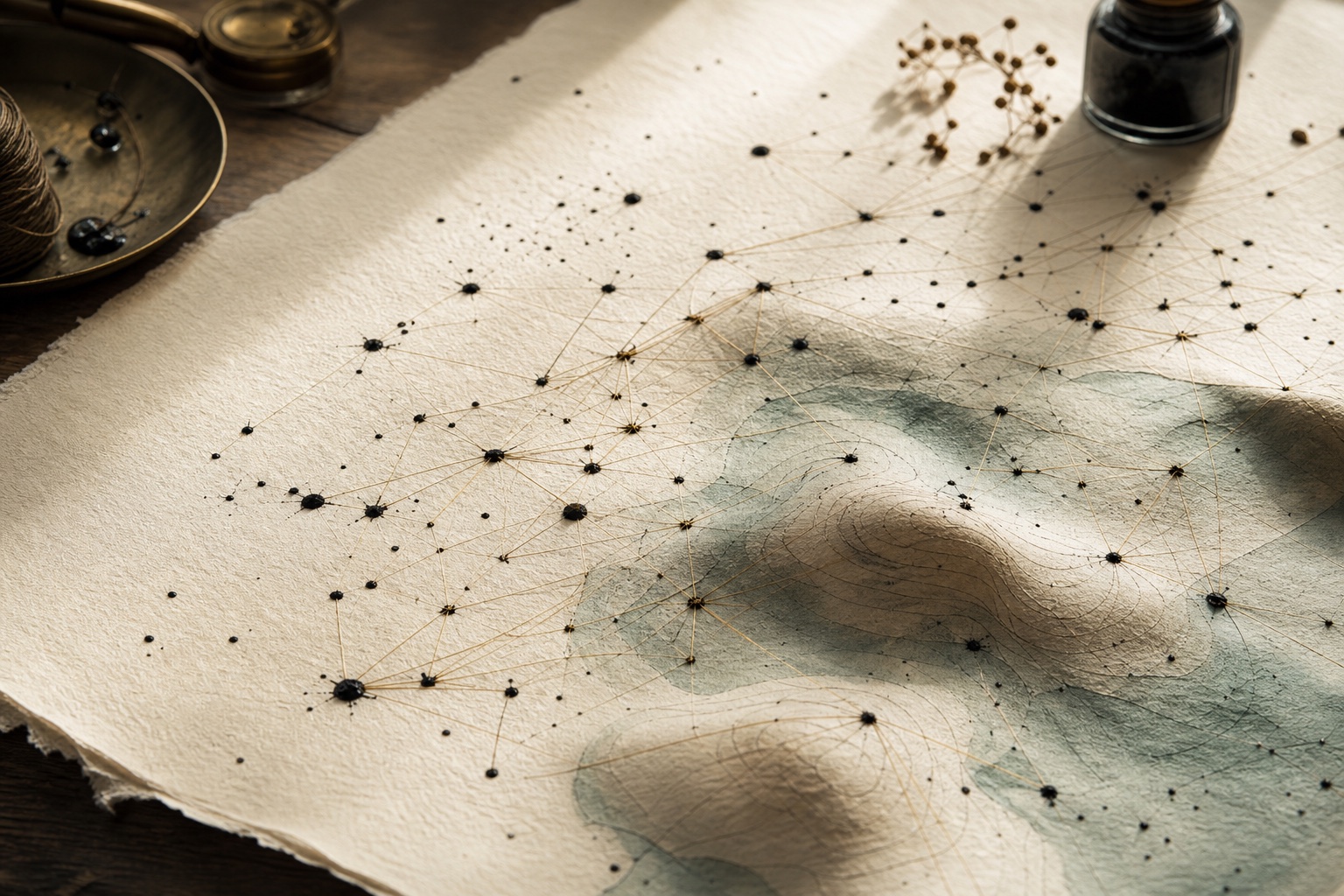
But physics has repeatedly shown that what feels immediate may be composite.
Temperature feels direct. But it arises from the motion and distribution of many particles. Solidity feels direct. But it arises from electromagnetic forces, quantum exclusion, and the collective behavior of atoms. Sound feels like a continuous wave in the air. But air is molecular. The wave is a large-scale organization of countless collisions.
None of this makes temperature, solidity, or sound unreal.
It changes the level at which we explain them.
A melody is not a single vibration. A wave is not a single molecule. A heartbeat is not a single cell. These phenomena exist because many smaller events are coordinated in just the right way. Their reality is not weakened by that dependence. In many cases, it is made intelligible by it.
Spacetime may require a similar adjustment, but more difficult because spacetime is where we usually place all adjustments.
We can accept that thunder is emergent because it happens in space and time. We can accept that a crystal’s rigidity is emergent because the atoms occupy positions. But to ask whether space and time themselves arise is to remove the floor from beneath the explanation.
No wonder the idea feels vertiginous.
Yet the goal is not to deny the floor. It is to understand how floors come to be.
Emergence does not erase a phenomenon. It gives the phenomenon an ancestry.
Gravity as a clue, not an ornament
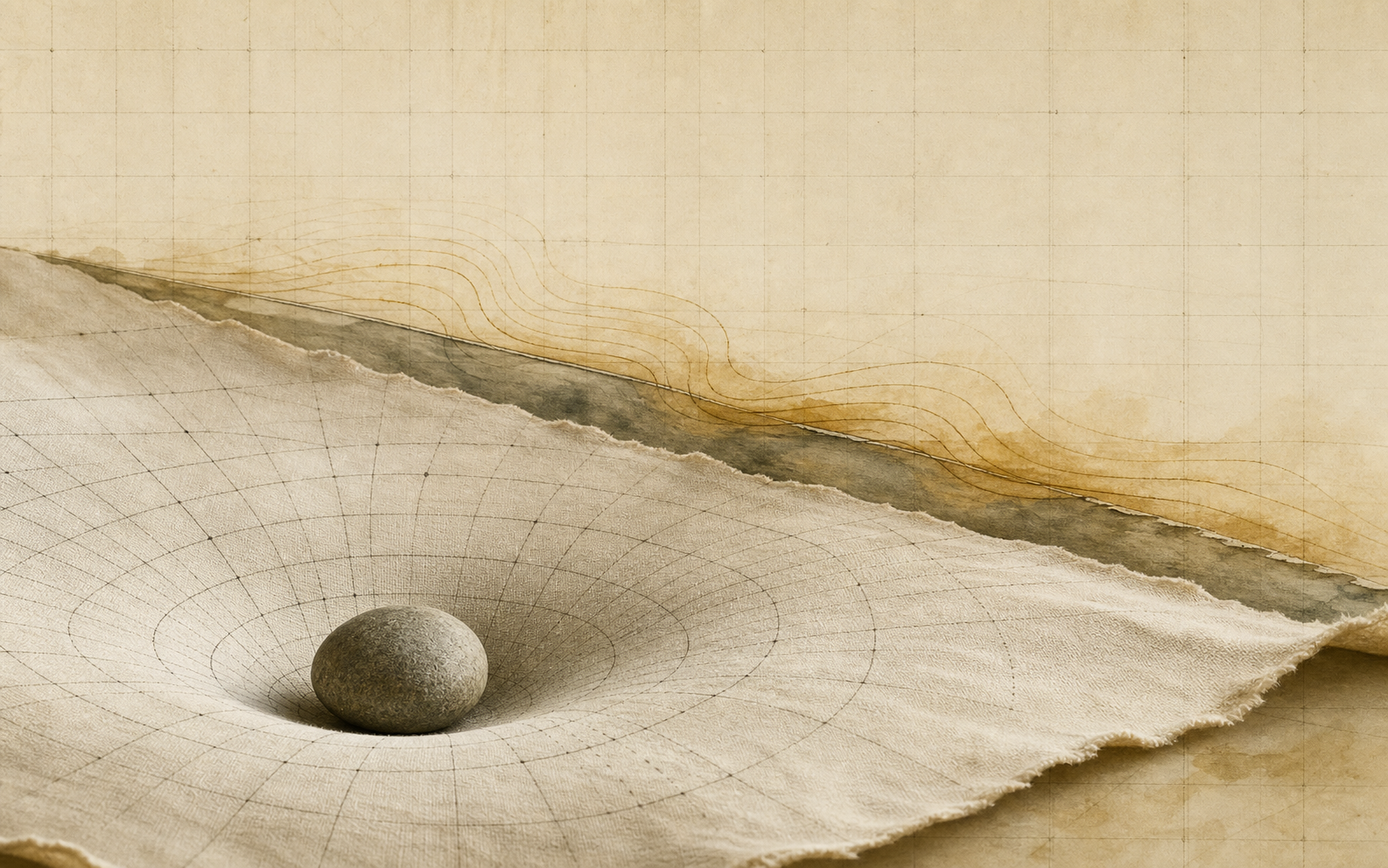
Gravity is the part of this story that refuses to stay decorative.
If the issue were only quantum entanglement, one might imagine spacetime emerging as a kind of abstract arrangement with no gravitational force attached. But the deepest clues tie geometry to entropy and entropy to gravity.
Einstein’s equations themselves can be read, in certain approaches, as having a thermodynamic flavor. Under special assumptions, the curvature of spacetime is related to the flow of heat and entropy across local horizons. This does not reduce general relativity to ordinary thermodynamics, but it suggests that gravitational dynamics may resemble an equation of state.
An equation of state is not usually fundamental. The pressure of a gas, for instance, is related to temperature and volume because molecules behave collectively in certain ways. Pressure is real. It pushes pistons. It drives weather. But it is not a separate microscopic ingredient.
Could spacetime curvature be something like that?
A large-scale rule obeyed by underlying degrees of freedom we do not yet fully understand?
This is one of the reasons the phrase “emergent gravity” is both tempting and dangerous. Tempting, because so many clues point toward a thermodynamic and informational reading of gravitational phenomena. Dangerous, because we do not yet know the final theory, and because the word “emergent” can be used too casually.
For a scientific idea, the question is never whether it sounds profound. The question is whether it explains, predicts, unifies, and survives contact with mathematics and observation.
On that standard, emergent spacetime is not a settled doctrine. It is a research direction with unusually deep motivation.
Its strength is not that it offers an easy answer.
Its strength is that several hard questions seem to lean toward it at once.
The problem with making a world
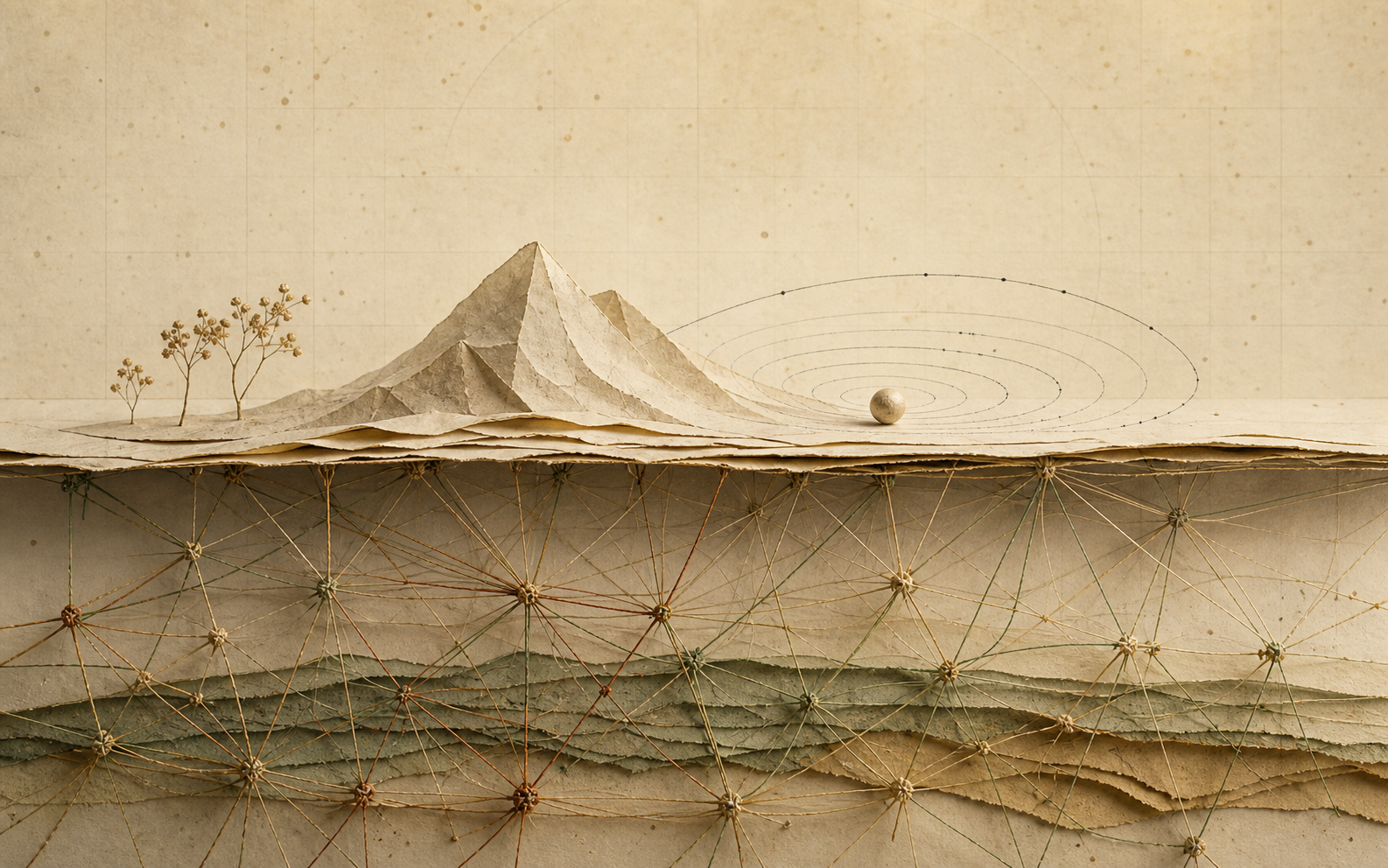
Suppose, for the sake of thought, that spacetime does arise from non-spatial quantum relations.
A new problem appears immediately.
Why is the world so stable?
Why does it not flicker wildly as the underlying quantum state changes? Why can a planet have an orbit, a mountain have a slope, a body have a location, a clock have a rhythm? Why does the large-scale world behave with such reliable grace?
This is where quantum error correction enters the story.
At first, error correction sounds like a technical tool for engineers. In classical computing, it means storing information redundantly so that if part of a system is damaged, the original message can still be restored. In quantum computing, error correction is subtler, because quantum information cannot simply be copied. Yet it can be protected by spreading it across many physical components in carefully structured ways.
The essential idea is this: information can be present in a whole system without being located in any single small part of it.
Lose some pieces, and the protected information may still be accessible from the rest. Disturb one part, and the logical structure can survive.
This has become unexpectedly important in holography.
In the best-understood models, information about a region of the gravitational spacetime can be encoded nonlocally in the underlying quantum system. Not stored at one obvious site. Not placed like a bead in a box. Distributed across patterns of entanglement in such a way that different collections of underlying degrees of freedom can contain enough to describe the same physical content.
That is astonishing.
It means the emergent spacetime is not necessarily a fragile mirage, vanishing if one microscopic component is disturbed. Its interior physics can have the robustness of a protected quantum code.
This helps explain how an ordinary-looking world could arise from something more abstract. The world would not need to be written point by point into microscopic locations. It could be stabilized by redundancy, constraint, and relational structure.
A place, in this view, is not a primitive container.
It is a protected feature of a larger pattern.
Error correction matters because a world made from relations must also be durable. It must survive small losses, disturbances, and partial views.
The mercy of redundancy
There is a human way to understand the importance of redundancy.
A city is not held together by one road. A language is not held together by one speaker. A memory is not held in one isolated neuron. A friendship is not one sentence but a history of gestures, repairs, jokes, recognitions, silences, returns.

Redundancy is not waste. It is how fragile things become livable.
Physics gives this intuition a sharper form. In quantum error correction, redundancy is not mere repetition. It is structured delocalization. The protected information belongs to correlations across the system.
This may be one reason spacetime feels so local even if its origin is not local in the ordinary sense.
Locality is the principle that things influence one another through nearby interactions, not by arbitrary action at a distance. It is one of the great stabilizers of physical explanation. Without locality, science would lose much of its grip. Causes could leap everywhere without discipline.
But in quantum gravity, locality may not be absolute at every level. It may be something that emerges when the underlying relational structure has the right organization.
This does not mean anything can affect anything else instantly. It means the familiar idea of “here” and “there” may be approximate, valid within the emergent spacetime but not necessarily meaningful in the same way beneath it.
That distinction matters.
When physicists question the fundamentality of locality, they are not throwing away the order of the world. They are asking why that order exists, why it is so good, and where its limits might be.
In the world of experience, locality is precious. It lets a child stack blocks, a surgeon operate, a planet orbit, a candle burn from wick to wax. It is not negotiable in daily life.
But perhaps locality is like the smoothness of water.
A wave has a crest and a trough. It travels across the sea. It can lift a boat. At the scale of ordinary experience, it is continuous and local. But beneath that description are molecules, collisions, thermal fluctuations, quantum rules. The wave is not false because it has a molecular account. The wave is the right description for the scale at which boats float.
So too, perhaps, with spacetime.
At our scale, it is the right description. The question is whether it is the earliest one nature uses.
A careful word about information

The word “information” can mislead as easily as it can illuminate.
In everyday speech, information means messages, facts, data, symbols, instructions. This invites bad pictures. One imagines the universe as a machine storing labels, or nature as a secret archive waiting to be read.
That is not the best way to think about it here.
In physics, information is tied to distinctions: which physical state a system is in, what can be predicted, what correlations exist, what transformations are possible, what cannot be erased without cost. Information is not a ghostly substance floating behind matter. It is not mind-stuff. It is not a replacement for physics.
It is a way of talking precisely about physical possibilities.
Black holes forced this language upon gravity because they raised the question of what happens to distinctions. If two different arrangements of matter collapse into black holes that look the same from outside, are those differences destroyed, hidden, transformed, or returned through radiation in some subtle form?
Quantum mechanics strongly resists true destruction of information. The evolution of a closed quantum system preserves distinctions in the quantum state, even when those distinctions become impossible for practical observers to track.
The black-hole information problem grew from the collision between this quantum principle and the apparent thermal evaporation of black holes. If a black hole radiates away completely, what happens to the detailed information about what formed it?
The modern view, influenced by holography, is that information is not simply lost. But the way it is preserved may be deeply nonclassical, involving correlations in radiation and structures that cannot be understood by treating spacetime as fixed and fundamental.
Here again, the lesson is not “everything is information” in a loose sense.
The lesson is that gravity seems to care about the bookkeeping of physical distinctions in a way no one expected.
Information, in this story, is not a cosmic whisper. It is the discipline of what can differ, what can be known, and what must be preserved.
The tenderness of the ordinary
A danger appears whenever we speak about emergence.
People hear “not fundamental” as “not real.” They hear dependence as demotion. They imagine a hierarchy in which only the bottom layer truly counts, and everything above it becomes decorative.
But science does not support that prejudice.
A hurricane is not less real than the water vapor and air currents that compose it. Life is not less real than chemistry. A thought is not less real because neurons are involved. A cathedral is not less real because it is made of stone, load-bearing forces, human labor, and time.
Reality has levels.
Some levels explain others. Some levels require others. But explanation is not cancellation.
The mistake is to treat fundamentality as the only respectable form of being. That is a metaphysical habit, not a scientific result.
The familiar world deserves more care than that.
If spacetime emerges, then walking across a room is still walking across a room. A clock still measures time. A falling apple still falls. The equations of general relativity still describe gravitational phenomena with extraordinary accuracy in their domain. The body still ages. The stars are still distant. Pain still matters. Beauty still arrives through the senses.
Emergence does not make the world thin.
It may make it deeper.
The ordinary world would be neither a sham nor the final explanation. It would be a real pattern with an underlying cause, a stable order whose reliability comes from something less familiar than points and distances.
The emotional shift is subtle but important.
We do not have to choose between naïve realism and disenchantment. We can say: the world we meet is genuine, but its genuineness may not depend on being ultimate.
There is humility in that.
There is also wonder.
What it would mean to be “beneath” space
It is hard to speak of something beneath spacetime, because “beneath” is itself a spatial word.
So is “before,” if time is also in question.
Our language is built inside the thing we are trying to examine. We say “deeper,” “underlying,” “prior,” and each word smuggles in a picture. But the mathematics may not need the picture. It may speak in terms of states, relations, transformations, symmetries, and constraints.
This is part of why the subject feels so difficult. We are not merely learning a new object within the world. We are learning how to loosen our grip on the grammar by which we place objects at all.
Still, some careful statements are possible.
An emergent spacetime proposal does not require that there is nothing. It does not require that the universe is mental. It does not require that experience is a deception. It says that the geometric features we know—distance, area, curvature, causal structure—may arise from non-geometric quantum facts.
Those facts may be relational rather than spatial. They may specify which degrees of freedom are entangled, how strongly, in what pattern, and under what rules of transformation. From such relations, in special circumstances, a smooth spacetime may appear as the effective description.
“Appear” here should not mean “seem falsely.” It should mean “become available at a certain scale.”
A coastline appears when rock meets sea. A temperature appears when microscopic motion is coarse-grained. A biological organism appears when chemistry becomes organized in a self-maintaining way. These are not hallucinations. They are levels at which nature has formed something with its own lawful behavior.
Spacetime, if emergent, would be the most intimate example of this pattern.
Not a thing appearing within an arena.
An arena-like order appearing from something that is not itself an arena.
The strange return of area
Let us return to area, because it is one of the quiet threads running through the whole story.
In black-hole thermodynamics, entropy scales with horizon area.
In holographic models, information associated with gravitational regions is controlled by surfaces.
In entanglement geometry, areas can measure patterns of quantum correlation.
In quantum error correction, the accessibility of a region is tied to how information is distributed across parts of the underlying system.
Area keeps appearing where volume might have been expected.
This repeated appearance is not a coincidence in the casual sense. It is a sign that the number of independent degrees of freedom in gravitational physics may be constrained differently from the way ordinary field theories in fixed spacetime suggest.
In a non-gravitational quantum field theory, one might be tempted to assign independent degrees of freedom to every tiny region of space. But gravity complicates this. Energy gravitates. Too much localization creates collapse. Horizons form. Entropy follows area. The very act of packing information into space changes the geometry one thought was merely hosting the information.
This is why gravity cannot simply be added at the end.
It changes the rules of counting.
And when counting changes, ontology may follow.
The area of a horizon is not just a measurement. It may be a clue about how nature limits the independence of places.
A universe that keeps its promises
The most beautiful thing about the emergent spacetime idea is not that it makes the world seem strange.
The world was already strange.
The beautiful thing is that it may explain why the world is so coherent.
Why does geometry obey equations? Why does gravity know about entropy? Why do black holes behave like thermodynamic objects? Why does entanglement, a quantum relation with no classical equivalent, seem capable of shaping spatial structure? Why does the information inside a gravitational region appear protected in ways reminiscent of quantum error-correcting codes?
These are separate questions until they are not.
A possible answer begins to form:
The familiar world may be a robust collective order arising from quantum relations constrained by information-theoretic principles. Gravity may be the large-scale behavior of that order. Locality may be a feature that appears when the order is smooth enough. Spacetime may be the way such an order presents itself to beings made inside it.
Again: may.
That word matters. A serious essay on this subject must leave room for ignorance. Physics is not finished. Our universe is not yet derived from a final theory of quantum gravity. Holographic dualities are powerful, but their most precise forms live in special settings. Cosmology raises questions that are not solved by importing lessons too quickly from black holes or idealized spacetimes.
But scientific caution should not be confused with lack of vision.
There are times when a field changes not because one experiment settles everything, but because many clues begin to point in the same surprising direction. The clues do not force belief. They invite disciplined imagination.
This is such a moment.
The ethics of wonder

There is a cheap kind of wonder that makes the world disappear.
It says: nothing is what it seems; everything familiar is merely a mask; the ordinary is a deception; only the hidden layer matters.
That is not wonder. It is impatience.
A better wonder lets the ordinary remain.
It does not need to empty the world of meaning in order to deepen it. It can look at a cup of coffee cooling on a table and see thermodynamics, molecular motion, quantum matter, stellar nucleosynthesis, and human habit without making the cup any less present.
The cup is not insulted by explanation.
Nor would space be insulted by emergence.
If spacetime arises from entanglement or informational structure, then the path from one room to another is still a path. The light crossing the room still crosses it. The delay between lightning and thunder still matters. The years of a life are not canceled because time may have a deeper account.
Scientific depth should return us to experience with greater fidelity, not contempt.
That is why the distinction between what is basic and what is real must be handled gently. The less basic thing may be the thing we inhabit most fully. It may be where meaning lives, where agency becomes possible, where organisms adapt, where memory and responsibility take form.
No one lives at the level of a final equation.
We live among emergent stabilities.
A world is not diminished by being made.
The open question
So where does this leave us?
With a possibility, not a verdict.
Spacetime may be fundamental, though modified in ways we do not yet understand. Or it may be emergent from a quantum substrate whose organizing principles are informational and relational. Or the final answer may make this contrast look naïve, replacing both options with a framework we cannot yet name.
What can be said is that black holes have made it difficult to think of spacetime as a passive container. Entanglement has made it difficult to think of separable things as the sole starting point. Holography has shown that gravitational worlds can, in certain settings, have equivalent non-gravitational accounts. Quantum error correction has shown how interior-like physics can be protected through distributed quantum structure.
Together, these ideas do not abolish the world.
They change the question we ask of it.
Not: Is the world merely apparent?
But: What must be true for a world like this to hold together?
That is a more generous question.
It lets the table remain solid, the stars remain distant, the body remain mortal, the horizon remain dark. It does not rush to declare victory over common sense. It asks how common sense becomes possible.
Perhaps the deepest surprise is not that spacetime could emerge.
Perhaps the deepest surprise is that emergence can be so faithful.
That from relations without ordinary distance, something like distance may arise.
That from quantum uncertainty, a classical world may steady itself.
That from entanglement, there may come rooms, roads, horizons, hands.
That from a more austere order, the world we know may gather—
not as a deception,
but as a real and luminous consequence.