An essay on connection and alignment
The River Between Us
Imagine two small boats at dusk, close enough to see each other's lanterns, not close enough to share a steering wheel. Every relationship begins somewhere like that.
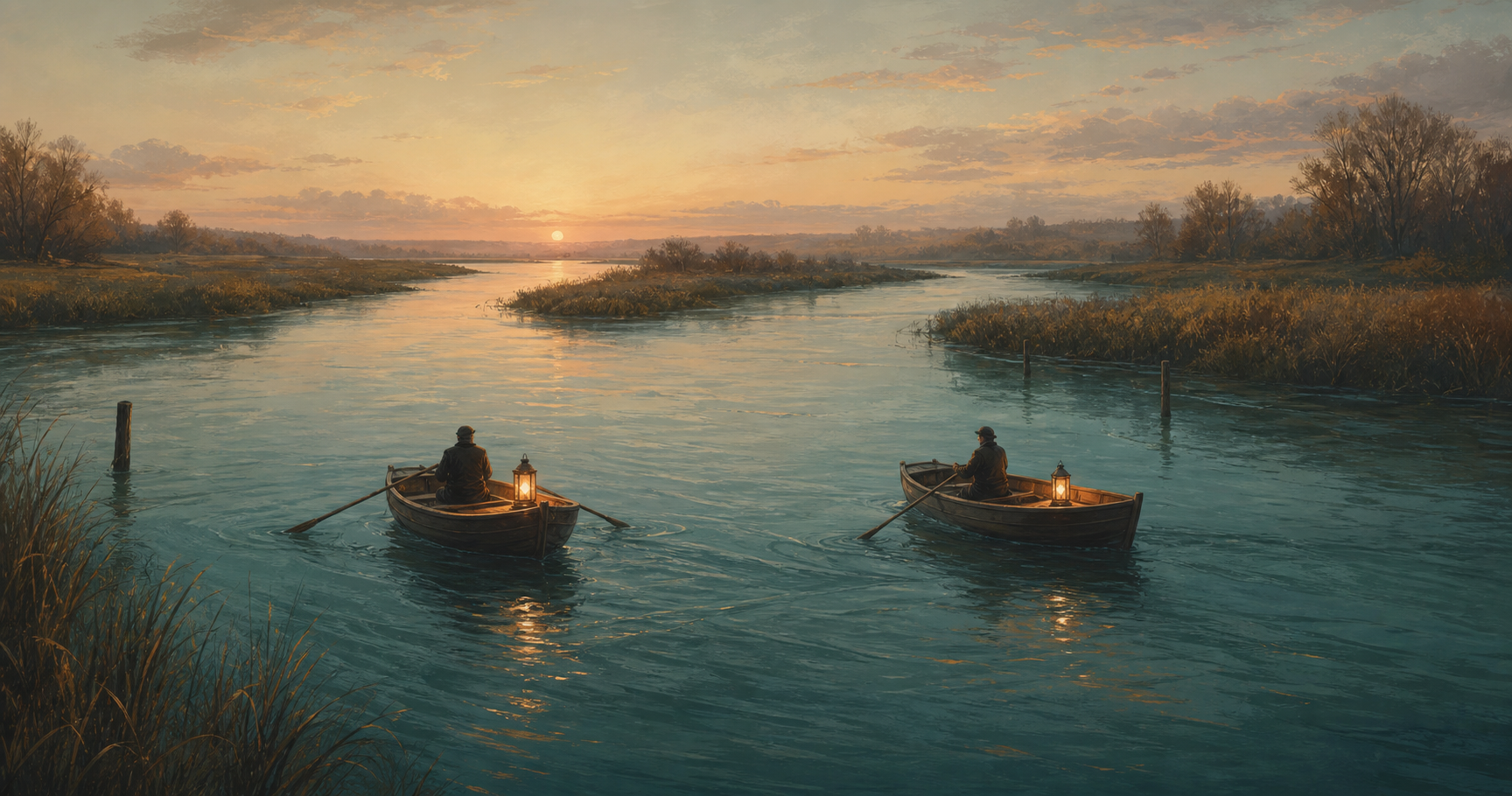
The river
Start with the river.
Two boats move through the same river, but they do not feel the same water. One is closer to the bank. One is near the fast middle channel. One has a crack in the hull. One carries more weight than it shows. Both people can be telling the truth from where they are.
Use the image simply. The river is the changing world neither person controls: time, stress, money, illness, family history, culture, luck, and the pressure of the moment. A boat is what each person brings and can partly steer: body, attention, habits, goals, needs, fears, memory, and tone of voice. A wake is the evidence your action leaves in someone else's world. Markers are shared memory: promises, rituals, laws, records, names, and standards.
That simple picture carries the harder question. Can two changing boats keep a route that works for both while the river keeps moving? There is no view from above the water. There are only partial readings, old maps, fresh wakes, and the work of staying close enough to keep steering together.
The current
The same words land in different water.
"Are you coming?" can be an invitation, a complaint, a fear of being abandoned, or a practical question about dinner. The sentence is small. The river around it is large.
Picture it arriving as a text while one person is packing a bag, late for the train, trying not to ask for reassurance too obviously. The other person is standing in a grocery aisle after a hard day, seeing only three plain words on a lit screen. One reads logistics. The other reads the delay, the punctuation, the silence after yesterday's argument, and the old fear of becoming less important.
Time changes the sentence. So does exhaustion, class, family history, illness, status, money, urgency, shame, and the last unresolved argument. An alignment researcher might call this partial observability in a nonstationary world: each person sees only part of the state, and the state keeps changing. You do not need the terms to know the feeling. We steer by incomplete light.
The boat
Each boat carries a private map.
You can see another person's words, face, schedule, and choices. You cannot see the whole map they are using. You may not see the body that did not sleep, the childhood that learned calm water was suspicious, the ambition that turns every pause into a scoreboard, or the old injury that treats ambiguity as danger.
A proxy is a stand-in for the thing we actually care about. Calm can stand in for trust. A launch date can stand in for good work. Politeness can stand in for respect. The danger comes when the stand-in takes the wheel. A couple can protect harmony until nobody tells the truth. A team can protect the launch date until safety becomes a nuisance. A child can protect being easy until they forget how to ask for care.
That is the human version of Goodhart's law: when a measure becomes the target, it can crowd out the value it was meant to protect. Dashboards are just the obvious place to see it. The same failure appears in kitchens, classrooms, meetings, friendships, institutions, and private self-talk whenever the visible score starts steering harder than the living value.
Attention helps because it keeps the map open. Instead of turning every splash into a grade - Did I fail? Do they respect me? Am I behind? - the boat can update: something changed; I am getting tense; they are pulling back; the room went quiet; my map may be stale. Attention works like a feedback loop. It keeps steering close to reality.
Drift
Sometimes the boats are steering toward different shores.
Some conflicts clear up when the missing context arrives. Others do not. One person may need stability while the other needs exploration. One may need short-term safety while the other is chasing long-term growth. One may have a hard limit where the other assumed flexibility. In those cases, the conflict is not just confusion. The boats may be pointed at different shores.
Attention still matters. It gives quicker truth: earlier signs of drift, clearer knowledge of what is shared, and better timing for repair or clean separation. But attention cannot make incompatible destinations compatible. A better map does not make two different shores become the same shore.
At first, the distance can look tiny. One person stops telling the full story because the other always fixes it too quickly. One friend stops inviting the other because the last three invitations were declined. A couple keeps the peace by avoiding the topic that slowly becomes the shape of the room. Six months later, nobody can point to the moment the boats separated. They can only see the water between them.
A team can drift the same way. In the launch meeting, everyone nods at the same slide. The product lead hears a promise to customers. The engineer hears a safety margin being spent. The designer hears quality becoming decoration. The newest person hears that dissent is welcome only after the decision has already hardened. The agenda says "launch date." The river says incentives, oversight, fear, legibility, and who will pay when the shortcut breaks.
This is distribution shift in human form. The steering rule that worked in one season may fail in another. A habit built for survival can become a source of harm when the water changes. Mature alignment begins when people can ask, without humiliation, whether the rule they are following still serves the life they are trying to build.
The wake
The wake teaches the next boat what to expect.
Every boat leaves a wake. A sentence, silence, delay, glance, joke, refusal, gift, boundary, or broken promise becomes part of the water another person has to cross. It changes what they expect next time.
This is why trust and mistrust are cumulative. A friend who shows up during a hard week leaves a wake. So does the joke that exposed a secret, the apology that subtly blamed the injured person, the manager who listened when no one else would, the parent who came back after cooling down. The event ends. The evidence remains.
For alignment, this is where legibility matters. Not showy clarity, but usable evidence: words and actions that help another person update accurately. A vague promise may feel generous to the speaker and unsafe to the listener. A boundary may feel cold in the moment and merciful over time. The harder question is: what did my wake make it reasonable for you to believe?
Repair
Repair means steering differently next time.
Forgiveness is not pretending the collision did not happen. Trust is not forgetting the rock. Repair begins when both people can look at the wake together and say what it cost to cross it.
A weak apology tries to settle the account while preserving the old policy: I am sorry you were hurt, now please treat the water as calm again. A stronger apology changes the steering. It asks: what did I fail to see, what proxy was I following, what constraint did I ignore, and what will be different when the same current returns?
Researchers use "corrigible" for a system that can be corrected. A human apology needs that quality. New information should alter future behavior. The apology matters only if the boat steers differently when the same current returns.
Sometimes the answer is a changed routine. Sometimes it is a boundary that makes future contact safer. Sometimes it is a slower tempo: pause, ask, repeat back, sleep, return. Sometimes it is the mercy of letting a relationship become smaller without making it false. The best repairs do not demand identical memories. They create enough shared reality for both boats to steer differently next time.

Culture
Culture leaves markers in the river.
Culture is shared memory outside any single boat. A promise remembers an intention after the mood that made it has passed. A recipe remembers a way to feed people. A wedding vow remembers a chosen duty. A calendar remembers when to gather. A traffic light remembers whose turn it is. A scientific standard remembers how to check a claim.
Markers help people coordinate when affection, charisma, and local memory cannot carry the load. Science uses replication and criticism. Law uses procedure and record. Markets use prices, contracts, and failure signals. Families use rituals, names, stories, and obligations. This is alignment infrastructure, but made of human memory.
Broken institutions leave bad markers. They reward legibility over truth, compliance over care, scale over accountability, proxy success over the human purpose that justified the system in the first place. Then the signs remain, but they point toward rocks. A society, like a person, can chase a target and destroy the context that made the target worth chasing.
Home water
Lanterns across the water.
When two people really begin to understand each other, they do not merge. They remain two boats, two centers of feeling, two private interiors. But something new appears between them: jokes that carry whole histories, unfinished sentences, a look across a crowded room, the ability to tell the truth without being immediately punished for it.
A good relationship becomes a shared map. For someone thinking about alignment, it is a shared model: never complete, never perfect, but good enough to notice danger sooner, recover from storms faster, and reach parts of the river neither person would have entered alone. It does not abolish uncertainty. It makes uncertainty navigable.
Connection is difficult because every person is a world in motion. It is beautiful for the same reason. Love does not erase the river or dissolve the distance between boats. It builds shared models, leaves lanterns on dark water, and makes a passage where there used to be only guessing. A life is not one boat reaching the sea alone, but all these fragile vessels, lights held out, calling across changing water, trying again and again to make the river between us passable.